Lesotho Update #9
Friday, April 28th, 2006 6:23 p.m.
Wow! Thank you for all the wonderful e-mails, once again I was crying in the Hlotse Internet Cafe. I'm blown away. I'm sorry I haven't had a chance to respond to them yet, but the internet was not working properly and I didn't have much time.
I am now (finally) in Maseru. I was unable to make it here yesterday, as it was a holiday and there were no hotel rooms in the whole city. I got here just a couple of hours ago and signed into my hotel, Lancer's Inn. Looks like I'm going to get to watch some TV tonight! I can't wait! Also, I'm going to go to a movie on Monday! I've really been missing some of the things that are so common in my regular life.
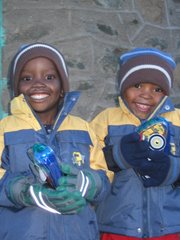
I fell in love with so many kids at Mahlekefane, but particularly with one little guy called Relebohile. He is a "single orphan" (meaning that one of his parents has passed away - a "double orphan" is what we would just call an "orphan" in Canada). The first day I met him, he and his mother and his baby sister were heading out to the fields behind my hut to pick maize (our corn). His little sister, as is custom, was strapped to the mother's back with a blanket and safety pin. He was walking along with her, in just a threadbare t-shirt and underwear. He is the most beautiful little boy, with enormous dark eyes that I spent many hours looking into and seeing my own reflection. At first, he was really shy with me, but his smile was easy and often contained his slightly protruding tongue. Over time, he became more and more comfortable with me and met me on my walk home from school. I taught him how to hold hands (which amazingly, the kids here don't know how to do with adults) and be carried on my hip. Eventually, we established a routine that my first greeting to him each day was to throw him into the air three or four times above my head much to his joy and a little bit of terror. Anytime I was inside my hut with the door closed, it was likely that Relebohile was standing outside, waiting for the door to open. And, if I went inside and left the door open, he would manoeuvre himself so that he could watch me inside. Before I left for Lesotho, Matt gave me his mini disk player (like a walkman) and several disks. I introduced Relebo to the earphones and the music pumped directly into his ears. He quickly learned how to crank up the volume and whenever he listened to music, I had to watch carefully so that I could turn it down when it was at an ear shattering level. In all the time that he and I were friends, and like I said, we spent countless hours together, often with him snuggled quietly in my lap, he rarely spoke to me. He spoke to his older brother and sister occasionally, but only in Sesotho. Most of my little Basotho buddies liked to repeat English words, but Relebo was SOOOO quiet with me. However, one day he was listening to the mini disk player and the song “Cabron” by the Red Hot Chilli Peppers came on. If you don’t know the song, download it, it will make this story so much better. In the song, the word “Cabron” is repeated over and over and over. As Relebo was listening to his tunes, I was playing solitaire and was shocked to suddenly hear him belting out the chorus, simply “Cabron, cabron….”. I laughed aloud and he joined me, continuing to entertain me with his singing.
When I said goodbye to this little boy and tried to hug him, he wouldn’t put his head on my shoulder. Tears were silently flowing out of my eyes and he couldn’t take his eyes off of me, he was confused and perplexed to see his great buddy crying. I probably have over 100 photos of Relebo, so I’ll send them on as soon as I can (probably not until I return to Ottawa).
Tomorrow I am going on an adventure to a place called Ramabanta. I don’t know much about it other than that I am going to go “Pony Trekking” – a popular tourist activity here. A friend, Marnie Mitchel (who is a pharmacist at the Tsepong Clinic in Hlotse) is coming to pick me up and we are going for two days and one night to this hotel with two of her other friends (one of whom I think I’ve mentioned before, his name is Elliott and he’s from NYC, here for two years as a Peace Corps volunteer). I’ll be back to Maseru on Sunday evening, and I’ll hopefully be able to access e-mail then. If not, I’ll be online on Monday morning, and send details then.
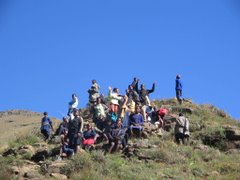
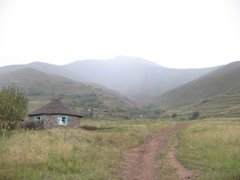
On my second last day at Mahlekefane, I finally got to climb the mountain that is the main feature of the village. It’s the highest peak around and the main part of the village (including the school and my own hut) are right at the bottom of it. Since my first day there, I knew I wanted to get to the top of the mountain, but the teacher who was supposed to accompany me was often out of the village – visiting his home or working on the census (which just ended after 2 ½ weeks). Monday, my second last day, was gorgeous. The sky was a bright blue with NO clouds and the sun was out, warming the cool air. As there were no adults to guide me at this point, my Basotho mother (the grade 2 teacher) suggested that I get two of the grade 7 boys to come up with me. I asked the principal if she thought it would be alright for me to take the entire grade 7 class with me. Since their teacher was away, and they all knew me well, she agreed. I had played a lot of “Hangman” with the students and they loved the game, so I put the mystery message on the board and had them solve it. After guessing all the letters, together they read aloud, “Today there is no class, we will all climb Maleqatse”. Upon reading it, they erupted in a cheer. We trouped out of the classroom and towards the shop, to buy “Simba” (ketchup flavoured cheesies) and apples. I bought one of each for each of the students and myself because I didn’t know how long the climb would take and wanted to make sure they all had a little snack. The climb ended up taking 3 hours to get up the mountain. Already in the highlands, I really struggled with my breathing as we climbed higher and higher. And when I say climbed, I mean it literally. We climbed up the centre of the mountain, I thought we’d be taking a hike, but we went directly up for over 2 hours of the climb. The hill was literally at a 45 degree angle and each step felt like the equivalent of about three stairs. As I was huffing and puffing and pushing myself up with all my might, the fit kids in their awful torn shoes were literally running up the mountain, some on all fours like little cats, wrestling with each other, cartwheeling, singing and dancing. They thought it was funny to see me struggle so much, but they were extremely supportive, taking turns holding the hands of “Madam” (they either call me “’M’e Shauna” or “Madam”, which cracks me up). Even the little boys gently took my hands and patiently helped me along, teaching me that “going like a snake” was easier. This was the technique whereby I crossed the mountain on more of a horizontal line and then turned back, almost retracing my steps, but going a little higher each time. Much slower, but in fact, much easier. After many children taking turns with Madam, and happily carrying my “kit” (backpack), we reached the summit. It was stunningly gorgeous, an absolutely perfect day for looking around 360 degrees, surrounded by beautiful blue mountains, none of which was higher than we were. The kids excitedly pointed out other villages, schools, herds of cattle and sheep to me. We sang several songs (including “The Lion Sleeps Tonight”, which they adore), ate our snacks and played “Broken Telephone”. Then, we went around the circle and had each child say something that was making them happy. (Note: Most of them said that they were happy to have eaten the apples and Simba I picked up before the trek!) It was beautiful to hear all the different things and to hear how proud they all were to be at the top of the mountain that casts a shadow over their school at sunset. Most of them had never climbed Maleqatse and were happy to have done it. They found porcupine quills under a rock towards the top of the mountain and many were wearing them in their short hair – looking like spiky warriors. They told me the quills were birds’ feathers and this led to a discussion of things that were more and less aerodynamic. I had no idea there were porcupines here, and none of them did either, but the dozens of quills were very exciting. Our peaceful talk was disturbed when two mangy dogs appeared over the crag of a rock and began barking viscously. The dogs here are NOT pets and are VERY scary. The kids jumped to their feet, screaming, and in the melee, knocked me over. After a shepherd called the dogs and they left, I was given much care and many apologies! We continued our games and ended with some photos and a few more songs. We then headed down the mountain. The wild, reckless children rolled, somersaulted and ran full tilt over rocks and steep mountain. I was constantly calling for them to “BE CAREFUL!” Not a single one was hurt in the least. They are amazingly fit and resilient kids. Turns out there is a much easier way to get up and down Maleqatse, you can walk on a gentle incline on the side of the mountain, over smaller peaks. This is the route we took down and I asked the kids WHY they took me straight up the middle of the mountain. They said they liked it better. I think they felt bad for Madam, and brought me down an easier, more careful route after seeing my struggle! When we got back down to the outskirts of the village, we were met with people of all ages, singing and ululating at our return. We were a pretty funny sight to them, I guess. Twenty-nine students in the middle of the afternoon, sweating, smiling and singing, being led down their mountain by the funny foreigner. They couldn’t understand the REASON for our climbing the mountain. People go places with a purpose, they don’t walk around or hike for exercise, fresh air or the view like we do. The kids told me just to tell them we were looking for a jackal. It was probably my favourite day so far, so fun and rewarding for us all to go as a group. I was hurting like crazy the next day – especially my bottom, which further entertained the students, who were still bouncing around and eager to run and play soccer and net ball.
I’ve had literally dozens of marriage proposals here, either from the men themselves or their family members. For a long time, I was polite, telling them thank you but I’m perfectly happy with my boyfriend in Canada. To this, most responded that I needed a boyfriend in Lesotho. I tried to just laugh this response off, but often the proposer would often continue to press. I have now begun to tell men the conditions of marriage to me in order to more quickly dissuade them. In Lesotho, in order to marry a woman, the man’s family must pay a bride price (“lobola”) to the family of the intended wife. I have begun to demand a lobola of either one hundred head of cattle (it’s usually 3-7), delivered to my parents in Canada. When they tell me they don’t have that, I offer the alternative lobola of the skin of the Kholumolumo, a mythical Basotho beast whose name means “Big Mouth”. This is met with laughter and the subject of marriage is dropped much faster than my previous method of reasoning.
Please keep the e-mails coming, I was surprised to hear that Prince Harry is here in Lesotho. He’s opening an orphanage right now and maybe I’ll run into him!
Friday, April 28th, 2006 6:23 p.m.
Wow! Thank you for all the wonderful e-mails, once again I was crying in the Hlotse Internet Cafe. I'm blown away. I'm sorry I haven't had a chance to respond to them yet, but the internet was not working properly and I didn't have much time.
I am now (finally) in Maseru. I was unable to make it here yesterday, as it was a holiday and there were no hotel rooms in the whole city. I got here just a couple of hours ago and signed into my hotel, Lancer's Inn. Looks like I'm going to get to watch some TV tonight! I can't wait! Also, I'm going to go to a movie on Monday! I've really been missing some of the things that are so common in my regular life.
I fell in love with so many kids at Mahlekefane, but particularly with one little guy called Relebohile. He is a "single orphan" (meaning that one of his parents has passed away - a "double orphan" is what we would just call an "orphan" in Canada). The first day I met him, he and his mother and his baby sister were heading out to the fields behind my hut to pick maize (our corn). His little sister, as is custom, was strapped to the mother's back with a blanket and safety pin. He was walking along with her, in just a threadbare t-shirt and underwear. He is the most beautiful little boy, with enormous dark eyes that I spent many hours looking into and seeing my own reflection. At first, he was really shy with me, but his smile was easy and often contained his slightly protruding tongue. Over time, he became more and more comfortable with me and met me on my walk home from school. I taught him how to hold hands (which amazingly, the kids here don't know how to do with adults) and be carried on my hip. Eventually, we established a routine that my first greeting to him each day was to throw him into the air three or four times above my head much to his joy and a little bit of terror. Anytime I was inside my hut with the door closed, it was likely that Relebohile was standing outside, waiting for the door to open. And, if I went inside and left the door open, he would manoeuvre himself so that he could watch me inside. Before I left for Lesotho, Matt gave me his mini disk player (like a walkman) and several disks. I introduced Relebo to the earphones and the music pumped directly into his ears. He quickly learned how to crank up the volume and whenever he listened to music, I had to watch carefully so that I could turn it down when it was at an ear shattering level. In all the time that he and I
 were friends, and like I said, we spent countless hours together, often with him snuggled quietly in my lap, he rarely spoke to me. He spoke to his older brother and sister occasionally, but only in Sesotho. Most of my little Basotho buddies liked to repeat English words, but Relebo was SOOOO quiet with me. However, one day he was listening to the mini disk player and the song “Cabron” by the Red Hot Chilli Peppers came on. If you don’t know the song, download it, it will make this story so much better. In the song, the word “Cabron” is repeated over and over and over. As Relebo was listening to his tunes, I was playing solitaire and was shocked to suddenly hear him belting out the chorus, simply “Cabron, cabron….”. I laughed aloud and he joined me, continuing to entertain me with his singing.
When I said goodbye to this little boy and tried to hug him, he wouldn’t put his head on my shoulder. Tears were silently flowing out of my eyes and he couldn’t take his eyes off of me, he was confused and perplexed to see his great buddy crying. I probably have over 100 photos of Relebo, so I’ll send them on as soon as I can (probably not until I return to Ottawa).
Tomorrow I am going on an adventure to a place called Ramabanta. I don’t know much about it other than that I am going to go “Pony Trekking” – a popular tourist activity here. A friend, Marnie Mitchel (who is a pharmacist at the Tsepong Clinic in Hlotse) is coming to pick me up and we are going for two days and one night to this hotel with two of her other friends (one of whom I think I’ve mentioned before, his name is Elliott and he’s from NYC, here for two years as a Peace Corps volunteer). I’ll be back to Maseru on Sunday evening, and I’ll hopefully be able to access e-mail then. If not, I’ll be online on Monday morning, and send details then.
On my second last day at Mahlekefane, I finally got to climb the mountain that is the main feature of the village. It’s the highest peak around and the main part of the village (including the school and my own hut) are right at the bottom of it. Since my first day there, I knew I wanted to get to the top of the mountain, but the teacher who was supposed to accompany me was often out of the village – visiting his home or working on the census (which just ended after 2 ½ weeks). Monday, my second last day, was gorgeous. The sky was a bright blue with NO clouds and the sun was out, warming the cool air. As there were no adults to guide me at this point, my Basotho mother (the grade 2 teacher) suggested that I get two of the grade 7 boys to come up with me. I asked the principal if she thought it would be alright for me to take the entire grade 7 class with me. Since their teacher was away, and they all knew me well, she agreed. I had played a lot of “Hangman” with the students and they loved the game, so I put the mystery message on the board and had them solve it. After guessing all the letters, together they read aloud, “Today there is no class, we will all climb Maleqatse”. Upon reading it, they erupted in a cheer. We trouped out of the classroom and towards the shop, to buy “Simba” (ketchup flavoured cheesies) and apples. I bought one of each for each of the students and myself because I didn’t know how long the climb would take and wanted to make sure they all had a little snack. The climb ended up taking 3 hours to get up the mountain. Already in the highlands, I really struggled with my breathing as we climbed higher and higher. And when I say climbed, I mean it literally. We climbed up the centre of the mountain, I thought we’d be taking a hike, but we went directly up for over 2 hours of the climb. The hill was literally at a 45 degree angle and each step felt like the equivalent of about three stairs. As I was huffing and puffing and pushing myself up with all my might, the fit kids in their awful torn shoes were literally running up the mountain, some on all fours like little cats, wrestling with each other, cartwheeling, singing and dancing. They thought it was funny to see me struggle so much, but they were extremely supportive, taking turns holding the hands of “Madam” (they either call me “’M’e Shauna” or “Madam”, which cracks me up). Even the little boys gently took my hands and patiently helped me along, teaching me that “going like a snake” was easier. This was the technique whereby I crossed the mountain on more of a horizontal line and then turned back, almost retracing my steps, but going a little higher each time. Much slower, but in fact, much easier. After many children taking turns with Madam, and happily carrying my “kit” (backpack), we reached the summit. It was stunningly gorgeous, an absolutely perfect day for looking around 360 degrees, surrounded by beautiful blue mountains, none of which was higher than we were. The kids excitedly pointed out other villages, schools, herds of cattle and sheep to me. We sang several songs (including “The Lion Sleeps Tonight”, which they adore), ate our snacks and played “Broken Telephone”. Then, we went around the circle and had each child say something that was making them happy. (Note: Most of them said that they were happy to have eaten the apples and Simba I picked up before the trek!) It was beautiful to hear all the different things and to hear how proud they all were to be at the top of the mountain that casts a shadow over their school at sunset. Most of them had never climbed Maleqatse and were happy to have done it. They found porcupine quills under a rock towards the top of the mountain and many were wearing them in their short hair – looking like spiky warriors. They told me the quills were birds’ feathers and this led to a discussion of things that were more and less aerodynamic. I had no idea there were porcupines here, and none of them did either, but the dozens of quills were very exciting. Our peaceful talk was disturbed when two mangy dogs appeared over the crag of a rock and began barking viscously. The dogs here are NOT pets and are VERY scary. The kids jumped to their feet, screaming, and in the melee, knocked me over. After a shepherd called the dogs and they left, I was given much care and many apologies! We continued our games and ended with some photos and a few more songs. We then headed down the mountain. The wild, reckless children rolled, somersaulted and ran full tilt over rocks and steep mountain. I was constantly calling for them to “BE CAREFUL!” Not a single one was hurt in the least. They are amazingly fit and resilient kids. Turns out there is a much easier way to get up and down Maleqatse, you can walk on a gentle incline on the side of the mountain, over smaller peaks. This is the route we took down and I asked the kids WHY they took me straight up the middle of the mountain. They said they liked it better. I think they felt bad for Madam, and brought me down an easier, more careful route after seeing my struggle! When we got back down to the outskirts of the village, we were met with people of all ages, singing and ululating at our return. We were a pretty funny sight to them, I guess. Twenty-nine students in the middle of the afternoon, sweating, smiling and singing, being led down their mountain by the funny foreigner. They couldn’t understand the REASON for our climbing the mountain. People go places with a purpose, they don’t walk around or hike for exercise, fresh air or the view like we do. The kids told me just to tell them we were looking for a jackal. It was probably my favourite day so far, so fun and rewarding for us all to go as a group. I was hurting like crazy the next day – especially my bottom, which further entertained the students, who were still bouncing around and eager to run and play soccer and net ball.
I’ve had literally dozens of marriage proposals here, either from the men themselves or their family members. For a long time, I was polite, telling them thank you but I’m perfectly happy with my boyfriend in Canada. To this, most responded that I needed a boyfriend in Lesotho. I tried to just laugh this response off, but often the proposer would often continue to press. I have now begun to tell men the conditions of marriage to me in order to more quickly dissuade them. In Lesotho, in order to marry a woman, the man’s family must pay a bride price (“lobola”) to the family of the intended wife. I have begun to demand a lobola of either one hundred head of cattle (it’s usually 3-7), delivered to my parents in Canada. When they tell me they don’t have that, I offer the alternative lobola of the skin of the Kholumolumo, a mythical Basotho beast whose name means “Big Mouth”. This is met with laughter and the subject of marriage is dropped much faster than my previous method of reasoning.
Please keep the e-mails coming, I was surprised to hear that Prince Harry is here in Lesotho. He’s opening an orphanage right now and maybe I’ll run into him!