Thursday, March 30th, 2007
Good afternoon, It is now 1 :16 p.m. Lesotho time (about 6 :16 a.m. in Ottawa)
(I'm finally getting around to sending this at 2:44 p.m. - most of you will be up already or getting up really soon! Have a fantastic day!)
I attempted to write this message this morning, and got about halfway through when the internet abruptly stopped working and my message was lost. I’ve been gone a couple of hours and just came back in, asking the manager if the internet will continue to work this time, he said that he wishes it will. I’m keeping my fingers crossed (which is very difficult when you type), but as a precaution, am writing this e-mail on Microsoft Word. When I was first in here this morning, I was met with lots of new e-mail messages. My eyes filled with tears and I was left clumsily wiping them away as I read message after message of love and encouragement. Thank you to all of you who are reading these messages and especially those of you who are taking the time to respond. The support means SO much to me. Thank you thank you thank you!
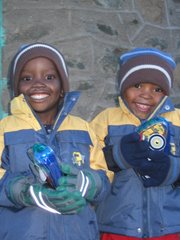
Today my shopping has continued, I have bought all the jackets and boots save for one set. I’ll stop by the shops this afternoon to look again.
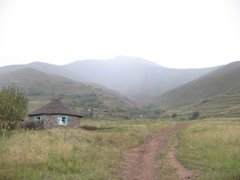
Let me tell you about my hut in Mahlekefane. I live in a round hut (called a rondavel), made of mud and cow dung with a beautiful thatch roof. It is quite roomy – with a radius of about 9 or 10 feet. There are a few closets in the single room, filled with the clothing and blankets of the Letata family (my hosts). I sleep on a double bed which has a mattress and a frame and is off the floor. I sleep under three Basotho blankets – very cozy and with a pillow made of my unused clothing. The pillows here are too lumpy for my liking, and after a few nights using them, I gave up for the softer clothing alternative.
I have bedside tables attached to my bed, on which I rest several candles – I like lots of light. When they’re extinguised at night, the darkness is so totally complete that you cannot see a thing. The mud floor is covered in linoleoum simulating wood and there is a short dressing table with three large mirrors. I was actually looking forward to being away from mirrors, but now I actually have to look at myself each morning, so I am happily using the warm water that my ‘M’e (Mother) brings me to bathe with.
I even have a small table in my hut, on which I sometimes eat (when I can escape the watchful eyes of all my friends in the village – they love to watch me eat!) soup. I am consistently fed HUGE meals and once in a while, need a break and have some instant soups in my hut. There is a huge bag of maize meal that the Letata family keeps in the hut in which I am living. There are also kitchen type cupboards in which they hold many dishes and cooking implements, as well as extra candles, sugar, flour, etc.
Like most families in Mahlekefane, the Letatas have more than one hut. Each hut is like a sepearte room and is used for a different purpose. I am sleeping the the ‘storage’ hut and they sleep in the ‘kitchen’. Pietir Letata is a coal miner who comes home for one or two nights a month and Ntsiseng, the 12 year old daughter lives with her grandparents, so it is just Menkalimeng (my ‘M’e) and Mahkumalo. They sleep together on a single cot in the corner of the very bare kitchen hut. When I asked why they do not use the beautiful hut in which I sleep, as I would be very happy to sleep on a single bed, ‘M’e tells me that she hates the cold. The kitchen hut is much warmer, as it is where all the cooking happens. Don’t think that I am being neglected though, the past few nights were pretty cold and I was given extra blenkets and the use of a neighbour’s heater for the evening (I’m being taken care of so well that I feel awful for all the people who need so much more and volunter to help ME out).
Anyway, my hut is a traditional Basotho hut, but well taken care of (like everything here! The four year olds learn to shine their shoes daily), and very comfortable. There is obviously no electricity or running water, but I will often wake up, feeling like I am in my own bed in Ottawa.
On the first day of the feast for the returning initiates, the men paraded into the field surrounded by their dogs. The dogs in Lesotho are not like our pets in Canada, some are beautiful, but they are trained not as housepets and companions but as vicious guards. The herders (the initates) have the most beautiful healthy dogs. When they arrived into the village, led by their proud dogs, each man and dog was decorated in red ochre. At the commencement of the ceremony, with the dogs settling in next to their singing masters, there was one dog sitting on the periphery with the women who I’m certain was frowning. He looked so sad. He kept approaching the area wiht the painted dogs and looked sadly around, obvioulsly envious of their adornments and high status. I got a photo of him hanging his head after he realized he truly didn’t fit in.
The family with which I live has a cat, named ‘katse’. The animals are not given names, but are simply called their Sesotho names (a dog is an ‘nja’). He is a tiny little cat who is very snarly and hissy. When I have tuna, I give him the water from the can. I’m trying to befriend him, but it’s not really working. His ears are both snipped at the tops. This is so that he will stay near home. Apparently he was running away to the ‘forest’ (there is, in fact, nothing CLOSE to a Canadian forest in Mahlekefane – there are maybe three gatherings of two small trees each), so I’m not sure where the cat was going. Nor am I sure where kids go to the toilet, as I am told they go in the ‘forest’), and in order to scare him from the forest and back home, Ntate Letata took him to the forest and snipped his ears. Thus forth, he stays near home. Yikes.
I am working wtih the children on basic vocabulary, including colours – which are fun and easy to teach, as you can point at anything to practice. Before I left for Hlotse yesterday morning, I went to visit my pal, Masefatsa who was resting in bed after a sudden seizure the night before (I am going to the hospital with her and her grandmother on Sunday). She was feeling OK, but tired and achy (understandably), and she began her favourite game of telling me colours of things. I would point at something and she would say the colour, my bracelet, ‘rrrred’ (she rolls her ‘r’s adorably), her blanket, ‘grrrreen’, a plant, also ‘grrrreen’. Then she pointed at my hand and said ‘white’. I pointed at her hand and asked what colour, she said, ‘grrrrreen’. Whatever you say. She also loves to be tickled – The Round and Round the Garden Game, Spiders Crawling Up Your Bag (note: this was supposed to say "Spiders Crawling Up Your Back", but it's pretty funny to leave the original typo) , and This Little Piggy. She’ll climb into my lap and present me with whatever part of her body she wants tickled. For the Round and Round, I am presented with a tiny perfect palm, Spiders get her head tucked down and her back rounded and the Piggies mean her shoe is kicked off and her tiny toes are in the air.
The kids have started to lead one another in the ‘Hands Up’ game we play. It’s great – they practice their English and warm up from the cold. One person shouts out directions which the group repeats and then does the action. They love ‘wiggle, wiggle, wiggle’ and ‘shake, shake, shake’. Everyday I try to expand the actions and vocabulary, but when they lead, they stick to the old standbys!
The day that the classrooms were being smeared, the kids were able to play with their toys outside. I saw some amazing things – the most detailed cars and trucks made out of wire (one had a trunk filled with Coke cans, rearview mirrors and even an accessory hanging from the main rearview!), the hoops and sticks similar to those who remember studying pioneer Canada, rocks used to play a checkers type game on a larger rock on which a gameboard has been set up using a small rock to carve into the surface, and many animals and houses made out of clay from the area surrounding the spring (we get water from the freshwater spring and I chlorinate it to drink). The toys I brought have been incorporated into their play beautifully.
I have been practising daily carrying things on my head, one of my steps in becoming a true ‘Masotho woman’. I carried a five litre bucket of water from the spring to the school with just one hand for balance. Pretty good. The women are helping me by constructing rings out of scarves for me to rest on my head as support. I am getting better though. Don’t be surprised if you see me walking the streets of Ottawa with a sewing machine or logs on my head (I have seen women carrying the most incredible things!)
I’ve pulled out my puppet (who’s name is ‘Bapala’ – Sesotho for play) a few times to hilarious reactions, some kids were initially terrified. Then Bapala started kissing some kids and the others all wanted in on the action. When I introduced Bapala to the adults, their reactions were identical – a few rough, grown men screamed and ran away in terror to the laughter of their friends, while some happily accepted Bapala’s kisses. One man tried to get a kiss from me instead of Bapala but I laughed it off (as I do with the numerous marriage proposals I recieve each day. People think that because I am white, I am rich and am their ticket to a better life. I wonder how one of these forward men would react if I just up and said yes. I’m not going to try, for fear that it would be binding!) Bapala now has a messy mouth and tongue from kissing so many people, but he and his fans are happy!
I gave the soccer balls along with other sports and school equpement to the principal, ‘M’e Ratia on Monday, and things were distributed on Tuesday afternoon. Along wtih the things I had brought, about 100 hats and a bunch of toothbrushes that were donated by other Help Lesotho volunteers were given out. The toothbrushes and paste were given to hte double and single orphans. A child here who has had one parent die is called a single orphan, and what we would call an orphan is here called a double orphan. The hats were given to the double orphans and all of the kids in calss one (the equivannet of our grade one, but with a big range of ages, from three to nine). ‘M’e Ratia handed out the new soccer balls, one to the girls for net ball (esentially basketball without the dribbling) and one to the boys for football (our soccer). The grade sevens are the ones who play, and all the other students, grade one to six stand on the sidelines. At first I thought, ‘how boring for them’. But then the game started. The grades one to sixes are responsible for provinding morale, they sing and dance (special morale boosting songs) and cheer things like ‘Many lions!’ in Sesotho (I think it’s like us yelling De-fence!) It’s fantastic to watch them in their physical education, the songs are all sung in beautiful harmony and the dance steps just add to the whole effect. The same thing happens when the grade sevens train for running. They run barefoot for 1 ½ hours as the younger students boost morale with song and dance. The kids are amazing runners and due to the high altitude and their incredible lung capacity, are fantastic competitors against the kids in the lowlands.
Primary school here is free and goes from grade one to grade seven. Grades 8-12 are high school and are called Form A, B, C, D and E. High school is expensive, so many children are unable to attend. This is why Help Lesotho sponsors many older children, as they are the ones who need help to pay school fees.
Tonight, the office staff and I have been invited to the neighbour’s for a maize roast (these are the three little boys and mother who live in a one room apartment next to the office). I have been recruited to bring marshmallows to roast and I’ll see if I can scrounge together some chocolate and graham cracker type cookies to let them try S’mores (there are cookies here called Maria biscuits which taste exactly like Arrowroots – yum!)
Even better than the Marie biscuits, though, are fat cakes. This is cakey dough that is deep fried in fat (usually corn oil these days). They are amazingly greasy and delicious adn taste like Tiny Tom’s doughnuts. On the way to the internet cafe, I saw a bunch of school girls heading past me carrying bags of them, apparently they can be purchased on the main street in town. I’ll go on a hunt after sending this e-mail!
Soon in Mahlekefane, there will be a World Food Program delivery and a cultural day with the traditional male and female dances. I can’t wait! I’ll tell you all about it in May, when I’ll be coming down next (Sam, I’ll be thinking of you on your birthday!)
Showing posts with label smearing. Show all posts
Showing posts with label smearing. Show all posts
Thursday, March 1, 2007

Lesotho Update #5
Wednesday, March 29th, 2006 (2:30 p.m. Lesotho time, about 7:30 a.m. in Ottawa)
It's been only ten days since my last e-mail, and I expected it to be much longer till the next, but I've had to come down from the mountain to get a few things done.
I have absolutely fallen in love with Mahlekefane and the people there.
The people in the village are in the process of building a new school room to replace the tent that was supplied years ago by the government in thes institution of free primary education. Help Lesotho has donated funds to pay for the building equipment for the roof (corrugated tin). I will be putting $1000 Canadian from donations into the school as well - we will help to cement the floors of all three school buildings. Doesn't sound like a big deal initially, but it really is.
Currently, the floors of the two existing buildings are made of cow dung mixed with mud. Sounds smelly, but once it's dry, you can't tell what it is (I know, as my hut is made of the very same materials). However, this material produces a disgusting amount of dust - covering the children, their clothes, their books, the new benches and desks donated by Help Lesotho, etc. The boys' job is to clean the blackboards and the girls to sweep the classroom (with brooms made by the boys). This is a big job daily. An even WORSE job is done every two weeks. It is called, appropriately, "smearing". Think of the grossest thing that comes to your mind with that word, and I'll beat it.
The girls collect piles of fresh cow dung from around the village, carry it bare handed to the school and proceed to take handfuls of it to the furthest corner of the classroom and smear the crap around. This takes an amazingly long time and cancels school for the entire day, as no one wants to walk on or work in a room freshly smeared with animal excrement. This is a dirty job that will become unnecessary when the floors will be cemented.
Additionally, each time the rooms are smeared, they shrink a little bit - considering it is done twice a month, this is significant. The girls smear the poop right to the edges of the walls, and the walls have long since lost shape. It is like a gradual slide between cieling and floor. This makes the crowded classroom even more crowded, as the tables are climbing up the wall. When a teacher attempts to circulate around the classroom, it is impossible. In consultation with the principal and teachers of the school, they felt that this would be the best way for the donated funds to be spent. The men in the village will have to dig through years of smeared layers in both the existing classrooms, creating more space, corners, way less dust and ultimately a much better learning environment.
I have so much to tell you. I have been gone for only 2 1/2 weeks, in Lesotho for just one day longer than two weeks, yet SO much has happened.
'M'e Ratia is the principal of Mahlekefane Primary School and the Godmother of the village. When she says "jump", you say "how high? how many times? and can I polish your shoes while I'm at it". Fortunately she is one of the kindest and most optimistic people I have ever met and uses her considerable power for only good. She is one of my two "Basotho" mothers. The other is 'M'e Letata, the daughter in law of the Chief, Ntate Sello. That makes the chief one of my two Basotho grandfathers. Grandpa Jack, your status is still safe, but you'll be happy to know that I have two grandfathers in this hemisphere who are guarding me with their lives. I also have two "boaussi" - sisters. 'M'e Letata has two daughters, Makhumalo - age 6, and Nsesiseng - age 12. In addition, 'M'e Ratia (the principal who calls me "her lahoa", her white person) calls her grandchildren my son and daughter, because we've become really close. Her grandson is Relabohile (meaning, "We are grateful) and is seven. "My daughter", Masefatsa is six. Along with Makhumalo, the two of them spend lots of time in my hut.
My hut is gorgeous, by the way. It is palatial, cozy and very much an African mud hut. I love it. It gets so dark there that I am able to fall asleep at 7:30 p.m.
On my second day in the village, 'M'e Ratia called me out of teaching the grade 7s for a special presentation. She and the chief were standing with a trembling sheep and announced to all that they were going to slaughter this animal in my honour. They made me touch him and take photos of him. That night, and for about five nights following, I was served sheep intestines and every other imaginable bit. Feeling really bad, I explained that I don't eat much red meat and that I was extremely honoured and humbled by the gesture, and that I would be happy to watch them enjoy the meat (something they eat only rarely). This went over very well actually. However, one of the school cooks has just given me her chicken (she only has one) for my eating pleasure. Before I left the village this morning, she made me look at it and said that I would eat it on Sunday. I'm not so good at looking at live things and then seeing them on my plate the next meal. It's much easier to buy meat at the grocery store - it's seperate from the animal it once was.
I'm getting a really unique experience, living in the village with these people. I am the first white person to stay there. There have been a few other volunteers from Help Lesotho that have stayed upto a week, but I'm part of the community for a month and a half and trying hard to convince them to treat me as one of them, not a guest. I am trying to learn to carry water on my head like the amazing women here. I was able to join the hard working teachers (who earn less than $200 Cdn a month, after the deductions from their pay such as a 15% Funeral Insurance fee!) in picking veggies from the huge school garden and washing them at the freshwater spring. They can bend at the back for hours and do so when cooking, sweeping, preparing food..., me, I have to use my knees. After helping with these preparations for an upcoming feast, I was invited to continue helping with preparations. I was led to a crowded hut where about a dozen women were working in the dark, peeling vegetables, cutting up pumpkin (which is delicious and sweet) and straining 400 L of homemade beer. It turns out that the new men, the "initiates" were set to return from six months of training in the mountains. This training is very secretive, not even their families know what happens, but they leave as boys and come back as ochre-red painted men. I was honoured to be able to help prepare the feast.
I learned how to filter the beer, with my hands over a homemade seive, patting and tapping it then squeezing out the sawdust like remnants of the grain that is used to make the beer. As I was helping, everyone was laughing and singing, and ululating (ayayayayayayay sound). I joined in and they loved it. As I strained beer, I was given my Sesotho name by 'M'e Ratia. In addition to being called 'M'e Shauna (Mother Shauna), the villagers now call me 'M'e Mathabo. It is the best Sesotho name I've ever heard and means the "Mother of Joy". What an honour to recieve this name from people who are more filled with happiness, joy and a love for life than anyone I have ever met. I provide the villagers with endless amusement, they are always laughing good-naturedly at me. I am told many times a day that they love me (with limited English, this phrase is relatively accessible to them). Everything I do is met with amusement, and deep belly laughs. I helped to carry stones from the makeshift quarry the villagers have made by digging into the moutain. They thought this was utterly hilarious.
I'm not always met with such joy, though. Most people in the village have seen white people before, but to some of the very young children, I am the very first they have ever seen. On my first full day in Mahlekefane, I was walking alone from my hut to the school when I waved and smiled hello to a little "abuti" (boy) standing alone. His family owns four mangy dogs. The dogs in Lesotho are not pets, they are guard dogs and very aggressive. This particular little boy was startled by my appearance and began to scream in utter terror at this monster that was waving to him. His dogs abruptly burst into vicious snarls and terrifying barks. The boys' little friend, who was walking over for a visit took one look at the unfolding disaster and joined in a chorus of screams and crying. Stunned, I retreated and ran into three angry women who were demanding (I think) in Sesotho what I had done. I tried to explain through gesture and my tiny bit of Sesotho that I was saying hello. I was carrying with me a small plastic horse that I gave to them for the "boabuti" (little boys). They smiled and walked away. Later, at the preparations for the feast, 'M'e Ratia told the story to the gathered crowd and it was met with uproarious laughter. Two of the women in the room were the mothers and they loved the story. (Note: the two terrified wee boys wound up being Lehlilika and Rampuma - both of whom I became really close with over my time in Lesotho. I even sponsor Lehlilika now!)
This past weekend, we went to 'M'e Letata's "first parents" home (this is as opposed to her parents-in-law, her husband's parents). We had a lovely visit, as translated by 'M'e Letata. Her English is getting so much better since I've been here. I had brought many food supplies and candles for them. They were so grateful and lovely. Her father was not there as he was in a meeting with the chief. A grandmother who takes care of orphaned grandbabies had come to visit me a few days earlier and asked me to come to her house for a visit, clueless, I said yes. Turns out her house is the second highest one in the village, and we had to climb for quite some time to get there. I was puffing and panting as my sister Makhumalo bolted ahead, literally running circles around me. On our way up, we met with another little child who was terrified of me and my white skin. After a while, she warmed up to me a bit.
When we got to the home of the grandmother, she was so thrilled to have me that she presented me with several gifts. The generousity of these people is astounding, but they are so happy to give a gift, it is not possible to refuse anything. On our way down the mountain, we stopped back in on my grandparentsand they gave me a pumpkin and a homemade Basotho broom. Big hugs and several photos later, we were headed home.
The weekends are funny. I've only spent one there so far, but I understand it was pretty standard. The children save their shoes and pants for school days. They have very few clothes and thus spend weekends in dusty underpants, tattered tshirts and blankets (which everyone in town and in the villages wears here). They come in droves to the door of my hut to play, listen to stories and sing. It's great. I've made use of the Happy Factory cars (www.happyfactory.com), Michele White's many small animal toys, flash cards and a pocket chart, numerous story books, my puppet (named "Bapala" - meaning play), balloons, stickers (so cute to see the teen boys' faces covered in neon hearts and butterflies as they proudly strut). My house is a real gathering place, and I am so happy.
I'm teaching them basic English and they reciprocate by teaching me Sesotho - I'm very good at greetings and farm animals. And that's about it.
I have bought jackets and will buy winter shoes (they don't sell warm boots here - only gum boots) for the young children of the teachers. They have so little, yet treat me like a queen, attending to my every need and more. They will not accept money from me, so I often sneak some food into their homes, but as a thank you, I am buying things for their children, or the children of their children or siblings, who they care for.
I love the kids most of all. They are gorgeous and snuggly and laughter comes so easily. We play the Pony Game, Head and Shoulders and Follow the Leader games. Any attention is precious to them, as most are treated like little adults and have to do a lot of hard work and learn independence early.
Today, in Hlotse, I was walking "downtown" and a mother asked me if I wanted a baby boy - offering me her son. I said he's beautiful but no thank you. She offered me a little girl, thinking I just didn't like the gender. Mom, you'll be happy to hear, I also gratefully turned down that offer.
I got to see the homecoming of the initiates and their dogs, also painted with ochre. I was even brought into the forbidden area by the chief to take photos. The people here, children and adults love to have photos taken and I have taken over 1500 already!
I am able to see the real daily life, culture and even celebrations of these fascinating people and have been welcomed with open arms and hearts. I feel like I've known them all my life and feel so very fortunate to be a part of their lives, even for this short time. I could go on forever, but the internet cafe is closing in four minutes, so I have to sign off. I will be going back into the mountains soon and will not be down until the end of April.
Thank you all for your kind e-mails and best wishes. I am thinking of you, too and feel so blessed to have such supportive people in my life.
Please keep the e-mails coming, I will read them when I have a chance.
Love,'M'e Mathabo
(this name also means that I'm supposed to name my first born son "Thabo" - Joy!)
MacDonald/Jansen clan - thanks for the updates, my heart is with you and in the bones of your beautiful babies!
It's been only ten days since my last e-mail, and I expected it to be much longer till the next, but I've had to come down from the mountain to get a few things done.
I have absolutely fallen in love with Mahlekefane and the people there.
The people in the village are in the process of building a new school room to replace the tent that was supplied years ago by the government in thes institution of free primary education. Help Lesotho has donated funds to pay for the building equipment for the roof (corrugated tin). I will be putting $1000 Canadian from donations into the school as well - we will help to cement the floors of all three school buildings. Doesn't sound like a big deal initially, but it really is.
Currently, the floors of the two existing buildings are made of cow dung mixed with mud. Sounds smelly, but once it's dry, you can't tell what it is (I know, as my hut is made of the very same materials). However, this material produces a disgusting amount of dust - covering the children, their clothes, their books, the new benches and desks donated by Help Lesotho, etc. The boys' job is to clean the blackboards and the girls to sweep the classroom (with brooms made by the boys). This is a big job daily. An even WORSE job is done every two weeks. It is called, appropriately, "smearing". Think of the grossest thing that comes to your mind with that word, and I'll beat it.
The girls collect piles of fresh cow dung from around the village, carry it bare handed to the school and proceed to take handfuls of it to the furthest corner of the classroom and smear the crap around. This takes an amazingly long time and cancels school for the entire day, as no one wants to walk on or work in a room freshly smeared with animal excrement. This is a dirty job that will become unnecessary when the floors will be cemented.
Additionally, each time the rooms are smeared, they shrink a little bit - considering it is done twice a month, this is significant. The girls smear the poop right to the edges of the walls, and the walls have long since lost shape. It is like a gradual slide between cieling and floor. This makes the crowded classroom even more crowded, as the tables are climbing up the wall. When a teacher attempts to circulate around the classroom, it is impossible. In consultation with the principal and teachers of the school, they felt that this would be the best way for the donated funds to be spent. The men in the village will have to dig through years of smeared layers in both the existing classrooms, creating more space, corners, way less dust and ultimately a much better learning environment.
I have so much to tell you. I have been gone for only 2 1/2 weeks, in Lesotho for just one day longer than two weeks, yet SO much has happened.
'M'e Ratia is the principal of Mahlekefane Primary School and the Godmother of the village. When she says "jump", you say "how high? how many times? and can I polish your shoes while I'm at it". Fortunately she is one of the kindest and most optimistic people I have ever met and uses her considerable power for only good. She is one of my two "Basotho" mothers. The other is 'M'e Letata, the daughter in law of the Chief, Ntate Sello. That makes the chief one of my two Basotho grandfathers. Grandpa Jack, your status is still safe, but you'll be happy to know that I have two grandfathers in this hemisphere who are guarding me with their lives. I also have two "boaussi" - sisters. 'M'e Letata has two daughters, Makhumalo - age 6, and Nsesiseng - age 12. In addition, 'M'e Ratia (the principal who calls me "her lahoa", her white person) calls her grandchildren my son and daughter, because we've become really close. Her grandson is Relabohile (meaning, "We are grateful) and is seven. "My daughter", Masefatsa is six. Along with Makhumalo, the two of them spend lots of time in my hut.
My hut is gorgeous, by the way. It is palatial, cozy and very much an African mud hut. I love it. It gets so dark there that I am able to fall asleep at 7:30 p.m.
On my second day in the village, 'M'e Ratia called me out of teaching the grade 7s for a special presentation. She and the chief were standing with a trembling sheep and announced to all that they were going to slaughter this animal in my honour. They made me touch him and take photos of him. That night, and for about five nights following, I was served sheep intestines and every other imaginable bit. Feeling really bad, I explained that I don't eat much red meat and that I was extremely honoured and humbled by the gesture, and that I would be happy to watch them enjoy the meat (something they eat only rarely). This went over very well actually. However, one of the school cooks has just given me her chicken (she only has one) for my eating pleasure. Before I left the village this morning, she made me look at it and said that I would eat it on Sunday. I'm not so good at looking at live things and then seeing them on my plate the next meal. It's much easier to buy meat at the grocery store - it's seperate from the animal it once was.
I'm getting a really unique experience, living in the village with these people. I am the first white person to stay there. There have been a few other volunteers from Help Lesotho that have stayed upto a week, but I'm part of the community for a month and a half and trying hard to convince them to treat me as one of them, not a guest. I am trying to learn to carry water on my head like the amazing women here. I was able to join the hard working teachers (who earn less than $200 Cdn a month, after the deductions from their pay such as a 15% Funeral Insurance fee!) in picking veggies from the huge school garden and washing them at the freshwater spring. They can bend at the back for hours and do so when cooking, sweeping, preparing food..., me, I have to use my knees. After helping with these preparations for an upcoming feast, I was invited to continue helping with preparations. I was led to a crowded hut where about a dozen women were working in the dark, peeling vegetables, cutting up pumpkin (which is delicious and sweet) and straining 400 L of homemade beer. It turns out that the new men, the "initiates" were set to return from six months of training in the mountains. This training is very secretive, not even their families know what happens, but they leave as boys and come back as ochre-red painted men. I was honoured to be able to help prepare the feast.
I learned how to filter the beer, with my hands over a homemade seive, patting and tapping it then squeezing out the sawdust like remnants of the grain that is used to make the beer. As I was helping, everyone was laughing and singing, and ululating (ayayayayayayay sound). I joined in and they loved it. As I strained beer, I was given my Sesotho name by 'M'e Ratia. In addition to being called 'M'e Shauna (Mother Shauna), the villagers now call me 'M'e Mathabo. It is the best Sesotho name I've ever heard and means the "Mother of Joy". What an honour to recieve this name from people who are more filled with happiness, joy and a love for life than anyone I have ever met. I provide the villagers with endless amusement, they are always laughing good-naturedly at me. I am told many times a day that they love me (with limited English, this phrase is relatively accessible to them). Everything I do is met with amusement, and deep belly laughs. I helped to carry stones from the makeshift quarry the villagers have made by digging into the moutain. They thought this was utterly hilarious.
I'm not always met with such joy, though. Most people in the village have seen white people before, but to some of the very young children, I am the very first they have ever seen. On my first full day in Mahlekefane, I was walking alone from my hut to the school when I waved and smiled hello to a little "abuti" (boy) standing alone. His family owns four mangy dogs. The dogs in Lesotho are not pets, they are guard dogs and very aggressive. This particular little boy was startled by my appearance and began to scream in utter terror at this monster that was waving to him. His dogs abruptly burst into vicious snarls and terrifying barks. The boys' little friend, who was walking over for a visit took one look at the unfolding disaster and joined in a chorus of screams and crying. Stunned, I retreated and ran into three angry women who were demanding (I think) in Sesotho what I had done. I tried to explain through gesture and my tiny bit of Sesotho that I was saying hello. I was carrying with me a small plastic horse that I gave to them for the "boabuti" (little boys). They smiled and walked away. Later, at the preparations for the feast, 'M'e Ratia told the story to the gathered crowd and it was met with uproarious laughter. Two of the women in the room were the mothers and they loved the story. (Note: the two terrified wee boys wound up being Lehlilika and Rampuma - both of whom I became really close with over my time in Lesotho. I even sponsor Lehlilika now!)
This past weekend, we went to 'M'e Letata's "first parents" home (this is as opposed to her parents-in-law, her husband's parents). We had a lovely visit, as translated by 'M'e Letata. Her English is getting so much better since I've been here. I had brought many food supplies and candles for them. They were so grateful and lovely. Her father was not there as he was in a meeting with the chief. A grandmother who takes care of orphaned grandbabies had come to visit me a few days earlier and asked me to come to her house for a visit, clueless, I said yes. Turns out her house is the second highest one in the village, and we had to climb for quite some time to get there. I was puffing and panting as my sister Makhumalo bolted ahead, literally running circles around me. On our way up, we met with another little child who was terrified of me and my white skin. After a while, she warmed up to me a bit.
When we got to the home of the grandmother, she was so thrilled to have me that she presented me with several gifts. The generousity of these people is astounding, but they are so happy to give a gift, it is not possible to refuse anything. On our way down the mountain, we stopped back in on my grandparentsand they gave me a pumpkin and a homemade Basotho broom. Big hugs and several photos later, we were headed home.
The weekends are funny. I've only spent one there so far, but I understand it was pretty standard. The children save their shoes and pants for school days. They have very few clothes and thus spend weekends in dusty underpants, tattered tshirts and blankets (which everyone in town and in the villages wears here). They come in droves to the door of my hut to play, listen to stories and sing. It's great. I've made use of the Happy Factory cars (www.happyfactory.com), Michele White's many small animal toys, flash cards and a pocket chart, numerous story books, my puppet (named "Bapala" - meaning play), balloons, stickers (so cute to see the teen boys' faces covered in neon hearts and butterflies as they proudly strut). My house is a real gathering place, and I am so happy.
I'm teaching them basic English and they reciprocate by teaching me Sesotho - I'm very good at greetings and farm animals. And that's about it.
I have bought jackets and will buy winter shoes (they don't sell warm boots here - only gum boots) for the young children of the teachers. They have so little, yet treat me like a queen, attending to my every need and more. They will not accept money from me, so I often sneak some food into their homes, but as a thank you, I am buying things for their children, or the children of their children or siblings, who they care for.
I love the kids most of all. They are gorgeous and snuggly and laughter comes so easily. We play the Pony Game, Head and Shoulders and Follow the Leader games. Any attention is precious to them, as most are treated like little adults and have to do a lot of hard work and learn independence early.
Today, in Hlotse, I was walking "downtown" and a mother asked me if I wanted a baby boy - offering me her son. I said he's beautiful but no thank you. She offered me a little girl, thinking I just didn't like the gender. Mom, you'll be happy to hear, I also gratefully turned down that offer.
I got to see the homecoming of the initiates and their dogs, also painted with ochre. I was even brought into the forbidden area by the chief to take photos. The people here, children and adults love to have photos taken and I have taken over 1500 already!
I am able to see the real daily life, culture and even celebrations of these fascinating people and have been welcomed with open arms and hearts. I feel like I've known them all my life and feel so very fortunate to be a part of their lives, even for this short time. I could go on forever, but the internet cafe is closing in four minutes, so I have to sign off. I will be going back into the mountains soon and will not be down until the end of April.
Thank you all for your kind e-mails and best wishes. I am thinking of you, too and feel so blessed to have such supportive people in my life.
Please keep the e-mails coming, I will read them when I have a chance.
Love,'M'e Mathabo
(this name also means that I'm supposed to name my first born son "Thabo" - Joy!)
MacDonald/Jansen clan - thanks for the updates, my heart is with you and in the bones of your beautiful babies!
Subscribe to:
Posts (Atom)