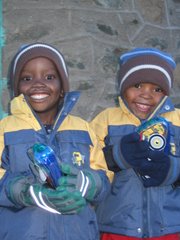
This is the other little guy I fell head over heels for. Totally different from Relebo, but a good buddy of his.
He's super independent, going up and down Maleqatse all by himself at the ripe old age of four.
My favourite moments were when I held Lehlilika on one knee and Relebo on the other and just chattered with them in Sesenglish (a mix, obviously of Sesotho and English).
Walking home from school each day and having these two run up to me and greet me can't be beaten.
I wish they were waiting for me every day here in Ottawa to greet me. It never failed to put a huge smile on my face.
No matter how tired I was, I always mustered up the energy to scoop each one up and toss him in the air, then carry him back to my hut on my hip, or with his little hand in mine.
I tickled Lehlilika
When I was between villages, I decided with my boyfriend to sponsor Relebo and Lehlilika, so that, despite family situations (Relebo will be a double orphan soon and Lehlilika's 8 year old brother has left school to be a herd boy in order to help support the family), they will both attend school. A tiny bit of money each year will facilitate this. My friend was just in Lesotho and has a photo of the two of them in their uniforms. They started attending school half a year early, because two free meals are supplied there and they need food in their little bellies.
Saturday, April 28, 2007

My darling, darling Relebo
Relebo was almost five when I was staying at Mahlekefane.
I really really hope to get back soon, but I wonder if he'll remember me. I don't know that I have all that many memories from when I was five.
I hope he does.
Because I certainly haven't forgotten him.
He's one of those people, that, for me, has really left the cliched footprints on my heart. Totally indelibly. (Not in-edibly, in-delibly, as in un-erasable).
These are amazing toys, much better than regular balloons, as they are so sturdy. They don't break and make a mess nearly as easily.
Masefatsa and Relebo Sing in English and Sesotho
Masefatsa and Relebohile (it's a common boys' name meaning "we are grateful") spent a lot of time in my hut, playing with me, and often performing for me. They are the granddaughter and great-nephew of the principal of Mahlekefane RC (Roman Catholic) Primary, 'M'e Ratia. They were absolutely adorable and treated each other like brother and sister.
Here they are singing in the hilariously bastardized English of rural Lesotho (I don't know how they got the lyrics for this strange song)
And this is them singing in Sesotho
Here they are singing in the hilariously bastardized English of rural Lesotho (I don't know how they got the lyrics for this strange song)
And this is them singing in Sesotho
Makhumalo Laughing
My gorgeous little Basotho sister, Makhumalo, has the greatest laugh. She's six and here she's sitting on my belly as I make faces which she copies and then I tickle her.
Man, I miss these kids.
Man, I miss these kids.
Basotho Dancing - Mokhibo, Mohobelo and Richa Tetsi
I attended a feast of celebration for a local governement official, as a guest of honour. I felt kind of ridiculous and overly celebrated myself, as I got to sit in a place of prominence (under a tent) and was treated exceptionally well. I was also asked to make an impromptu speech after the hours of performances and speeches. Bear in mind, I barely speak the language, only a few words. Also, there is no electricity in the village, but members of the four surrounding villages attended, and a mic was actually hooked into the power supply from an old beat up pick-up. I demonstrated my "tricks", my Sesotho greetings and then pulled out the old stand-bys, lots of gesticulation, a huge smile and ululation (you'll hear some others ululating the background of these videos).
Here is the men's traditional Basotho dance - Mohobelo....
...And the women's - Mokhibo...
...And a not-so-traditional dance - Richa Tetsi entertaining the other kids
For some reason, Richa Tetsi reminded me of Charlie. It's probably the lankiness. And they're both pretty shy, but when they come out of their shells - look out!
He was 16 and dropped out of grade 4 halfway through my time in Mahlekefane. I was glad to see that he returned to classes.
Singing in the dark
This isn't all that impressive to watch, maybe, but it is incredible singing. There was some really cool dancing as well, but clearly there wasn't enough light to capture the full effect.
I can't belive how well the people in Lesotho sing, harmonizing and complementing each other perfectly.
This was shot at Malealea, a tourist lodge where I was charged about one quarter of the usual cost because the owners said I qualified for the "Basotho" rate. I guess by the end of my trip, I'd learned enough to fit in with the locals! (Even despite my pale skin and sharp nose)
My little abuti
I'll still spontaneously start to cry when I think about my little Relebohile. I've never fallen in love with any person as quickly as I did with this little guy.
I can't believe how much I miss him.
I think about him several times a day and wish I could have brought him home with me.
It gives me so much comfort to know that my Basotho "mother" has agreed to adopt him when his own mother dies (his father has died of AIDS and his mother is on ARVs for full-blown AIDS as well).
When I took him to an AIDS clinic to be tested (thank goodness, he is negative) he sat on my lap for the whole car ride, thrilled as could be. He'd never been in a "koloi" before.
So many times, when I am doing something interesting, or even just doing something I do every day, like climb a stair case, take an elevator, walk down a busy street, watch TV, I think about what he'd think, how excited he'd be.
Lots of Rhythm in my Second Village, too
In Thaba Tseka, my second village, the kids were great singers and dancers too.
Here are some snippets of their performances.
The girls made their own skirts out of paper.
This is a favourite song of the littlest ones. It has something to do with frogs, and like most Sesotho songs, has actions.
Here are some snippets of their performances.
The girls made their own skirts out of paper.
This is a favourite song of the littlest ones. It has something to do with frogs, and like most Sesotho songs, has actions.
Goodbye Ceremony
This was a wonderful day, but also one of the saddest of my life. It was my last day in Mahlekefane, and the kids, grade by grade, did performances for me.
It was incredible.
I was bawling and singing and laughing all at the same time.
I wish I'd made longer videos, but here are some snippets.
It was incredible.
I was bawling and singing and laughing all at the same time.
I wish I'd made longer videos, but here are some snippets.
The Monkey Song
I taught this song to the grade 7 students. When they sang it in the classroom, it was very reserved and shy.
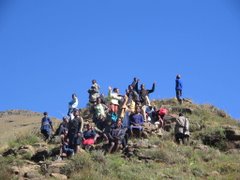
On my last day in Mahlekefane, I climbed the mountain that overlooks the village (Maleqatse) with all the grade 7s.
They let loose and really sang the song with vim and vigour.
The song was written by my little brothers and their buddy, Garrett years ago.
The actions come along with it and after the Basotho kids really got to know them, they would ask to go to the bathroom by doing the "pee and poo" swivel
The Concert
This is fantastic. The kids invited me to a concert and when I got there I realized it was to raise money for the school. In order to raise money, the donor chooses a song they'd like to hear and gives some change. The next donor chooses another song, interrupting the first, and makes a larger donation.
You donate and request through the coaches, who blow whistles to indicate that the song must change.
I gave them 10 Rand (about $1.20) and they all sang "Head and Shoulders".
Initiates returnining to Mahlekefane
After living in the mountains for three months, the young initiates end their secret training with circumcision and return to the village, triumphantly.
The chief of the village allowed me to take photos and video.
Tuesday, March 13, 2007
Lesotho National Anthem Video
At the beginning and end of every school day, the kids all join to pray, sing and hear announcements. Here is the final Lesotho national anthem on my final day in Mahlekefane. I'm very emotional and continue to video the kids as they run off towards home.
Morale Boosting Video
When the younger kids were training for sports, the older kids sang to provide "morale". You can't describe these songs.
Sunday, March 4, 2007

Lesotho Update #9

Lesotho Update #9
Friday, April 28th, 2006 6:23 p.m.
Wow! Thank you for all the wonderful e-mails, once again I was crying in the Hlotse Internet Cafe. I'm blown away. I'm sorry I haven't had a chance to respond to them yet, but the internet was not working properly and I didn't have much time.
I am now (finally) in Maseru. I was unable to make it here yesterday, as it was a holiday and there were no hotel rooms in the whole city. I got here just a couple of hours ago and signed into my hotel, Lancer's Inn. Looks like I'm going to get to watch some TV tonight! I can't wait! Also, I'm going to go to a movie on Monday! I've really been missing some of the things that are so common in my regular life.
I fell in love with so many kids at Mahlekefane, but particularly with one little guy called Relebohile. He is a "single orphan" (meaning that one of his parents has passed away - a "double orphan" is what we would just call an "orphan" in Canada). The first day I met him, he and his mother and his baby sister were heading out to the fields behind my hut to pick maize (our corn). His little sister, as is custom, was strapped to the mother's back with a blanket and safety pin. He was walking along with her, in just a threadbare t-shirt and underwear. He is the most beautiful little boy, with enormous dark eyes that I spent many hours looking into and seeing my own reflection. At first, he was really shy with me, but his smile was easy and often contained his slightly protruding tongue. Over time, he became more and more comfortable with me and met me on my walk home from school. I taught him how to hold hands (which amazingly, the kids here don't know how to do with adults) and be carried on my hip. Eventually, we established a routine that my first greeting to him each day was to throw him into the air three or four times above my head much to his joy and a little bit of terror. Anytime I was inside my hut with the door closed, it was likely that Relebohile was standing outside, waiting for the door to open. And, if I went inside and left the door open, he would manoeuvre himself so that he could watch me inside. Before I left for Lesotho, Matt gave me his mini disk player (like a walkman) and several disks. I introduced Relebo to the earphones and the music pumped directly into his ears. He quickly learned how to crank up the volume and whenever he listened to music, I had to watch carefully so that I could turn it down when it was at an ear shattering level. In all the time that he and I were friends, and like I said, we spent countless hours together, often with him snuggled quietly in my lap, he rarely spoke to me. He spoke to his older brother and sister occasionally, but only in Sesotho. Most of my little Basotho buddies liked to repeat English words, but Relebo was SOOOO quiet with me. However, one day he was listening to the mini disk player and the song “Cabron” by the Red Hot Chilli Peppers came on. If you don’t know the song, download it, it will make this story so much better. In the song, the word “Cabron” is repeated over and over and over. As Relebo was listening to his tunes, I was playing solitaire and was shocked to suddenly hear him belting out the chorus, simply “Cabron, cabron….”. I laughed aloud and he joined me, continuing to entertain me with his singing.
When I said goodbye to this little boy and tried to hug him, he wouldn’t put his head on my shoulder. Tears were silently flowing out of my eyes and he couldn’t take his eyes off of me, he was confused and perplexed to see his great buddy crying. I probably have over 100 photos of Relebo, so I’ll send them on as soon as I can (probably not until I return to Ottawa).
Tomorrow I am going on an adventure to a place called Ramabanta. I don’t know much about it other than that I am going to go “Pony Trekking” – a popular tourist activity here. A friend, Marnie Mitchel (who is a pharmacist at the Tsepong Clinic in Hlotse) is coming to pick me up and we are going for two days and one night to this hotel with two of her other friends (one of whom I think I’ve mentioned before, his name is Elliott and he’s from NYC, here for two years as a Peace Corps volunteer). I’ll be back to Maseru on Sunday evening, and I’ll hopefully be able to access e-mail then. If not, I’ll be online on Monday morning, and send details then.
On my second last day at Mahlekefane, I finally got to climb the mountain that is the main feature of the village. It’s the highest peak around and the main part of the village (including the school and my own hut) are right at the bottom of it. Since my first day there, I knew I wanted to get to the top of the mountain, but the teacher who was supposed to accompany me was often out of the village – visiting his home or working on the census (which just ended after 2 ½ weeks). Monday, my second last day, was gorgeous. The sky was a bright blue with NO clouds and the sun was out, warming the cool air. As there were no adults to guide me at this point, my Basotho mother (the grade 2 teacher) suggested that I get two of the grade 7 boys to come up with me. I asked the principal if she thought it would be alright for me to take the entire grade 7 class with me. Since their teacher was away, and they all knew me well, she agreed. I had played a lot of “Hangman” with the students and they loved the game, so I put the mystery message on the board and had them solve it. After guessing all the letters, together they read aloud, “Today there is no class, we will all climb Maleqatse”. Upon reading it, they erupted in a cheer. We trouped out of the classroom and towards the shop, to buy “Simba” (ketchup flavoured cheesies) and apples. I bought one of each for each of the students and myself because I didn’t know how long the climb would take and wanted to make sure they all had a little snack. The climb ended up taking 3 hours to get up the mountain. Already in the highlands, I really struggled with my breathing as we climbed higher and higher. And when I say climbed, I mean it literally. We climbed up the centre of the mountain, I thought we’d be taking a hike, but we went directly up for over 2 hours of the climb. The hill was literally at a 45 degree angle and each step felt like the equivalent of about three stairs. As I was huffing and puffing and pushing myself up with all my might, the fit kids in their awful torn shoes were literally running up the mountain, some on all fours like little cats, wrestling with each other, cartwheeling, singing and dancing. They thought it was funny to see me struggle so much, but they were extremely supportive, taking turns holding the hands of “Madam” (they either call me “’M’e Shauna” or “Madam”, which cracks me up). Even the little boys gently took my hands and patiently helped me along, teaching me that “going like a snake” was easier. This was the technique whereby I crossed the mountain on more of a horizontal line and then turned back, almost retracing my steps, but going a little higher each time. Much slower, but in fact, much easier. After many children taking turns with Madam, and happily carrying my “kit” (backpack), we reached the summit. It was stunningly gorgeous, an absolutely perfect day for looking around 360 degrees, surrounded by beautiful blue mountains, none of which was higher than we were. The kids excitedly pointed out other villages, schools, herds of cattle and sheep to me. We sang several songs (including “The Lion Sleeps Tonight”, which they adore), ate our snacks and played “Broken Telephone”. Then, we went around the circle and had each child say something that was making them happy. (Note: Most of them said that they were happy to have eaten the apples and Simba I picked up before the trek!) It was beautiful to hear all the different things and to hear how proud they all were to be at the top of the mountain that casts a shadow over their school at sunset. Most of them had never climbed Maleqatse and were happy to have done it. They found porcupine quills under a rock towards the top of the mountain and many were wearing them in their short hair – looking like spiky warriors. They told me the quills were birds’ feathers and this led to a discussion of things that were more and less aerodynamic. I had no idea there were porcupines here, and none of them did either, but the dozens of quills were very exciting. Our peaceful talk was disturbed when two mangy dogs appeared over the crag of a rock and began barking viscously. The dogs here are NOT pets and are VERY scary. The kids jumped to their feet, screaming, and in the melee, knocked me over. After a shepherd called the dogs and they left, I was given much care and many apologies! We continued our games and ended with some photos and a few more songs. We then headed down the mountain. The wild, reckless children rolled, somersaulted and ran full tilt over rocks and steep mountain. I was constantly calling for them to “BE CAREFUL!” Not a single one was hurt in the least. They are amazingly fit and resilient kids. Turns out there is a much easier way to get up and down Maleqatse, you can walk on a gentle incline on the side of the mountain, over smaller peaks. This is the route we took down and I asked the kids WHY they took me straight up the middle of the mountain. They said they liked it better. I think they felt bad for Madam, and brought me down an easier, more careful route after seeing my struggle! When we got back down to the outskirts of the village, we were met with people of all ages, singing and ululating at our return. We were a pretty funny sight to them, I guess. Twenty-nine students in the middle of the afternoon, sweating, smiling and singing, being led down their mountain by the funny foreigner. They couldn’t understand the REASON for our climbing the mountain. People go places with a purpose, they don’t walk around or hike for exercise, fresh air or the view like we do. The kids told me just to tell them we were looking for a jackal. It was probably my favourite day so far, so fun and rewarding for us all to go as a group. I was hurting like crazy the next day – especially my bottom, which further entertained the students, who were still bouncing around and eager to run and play soccer and net ball.
I’ve had literally dozens of marriage proposals here, either from the men themselves or their family members. For a long time, I was polite, telling them thank you but I’m perfectly happy with my boyfriend in Canada. To this, most responded that I needed a boyfriend in Lesotho. I tried to just laugh this response off, but often the proposer would often continue to press. I have now begun to tell men the conditions of marriage to me in order to more quickly dissuade them. In Lesotho, in order to marry a woman, the man’s family must pay a bride price (“lobola”) to the family of the intended wife. I have begun to demand a lobola of either one hundred head of cattle (it’s usually 3-7), delivered to my parents in Canada. When they tell me they don’t have that, I offer the alternative lobola of the skin of the Kholumolumo, a mythical Basotho beast whose name means “Big Mouth”. This is met with laughter and the subject of marriage is dropped much faster than my previous method of reasoning.
Please keep the e-mails coming, I was surprised to hear that Prince Harry is here in Lesotho. He’s opening an orphanage right now and maybe I’ll run into him!
Friday, April 28th, 2006 6:23 p.m.
Wow! Thank you for all the wonderful e-mails, once again I was crying in the Hlotse Internet Cafe. I'm blown away. I'm sorry I haven't had a chance to respond to them yet, but the internet was not working properly and I didn't have much time.
I am now (finally) in Maseru. I was unable to make it here yesterday, as it was a holiday and there were no hotel rooms in the whole city. I got here just a couple of hours ago and signed into my hotel, Lancer's Inn. Looks like I'm going to get to watch some TV tonight! I can't wait! Also, I'm going to go to a movie on Monday! I've really been missing some of the things that are so common in my regular life.
I fell in love with so many kids at Mahlekefane, but particularly with one little guy called Relebohile. He is a "single orphan" (meaning that one of his parents has passed away - a "double orphan" is what we would just call an "orphan" in Canada). The first day I met him, he and his mother and his baby sister were heading out to the fields behind my hut to pick maize (our corn). His little sister, as is custom, was strapped to the mother's back with a blanket and safety pin. He was walking along with her, in just a threadbare t-shirt and underwear. He is the most beautiful little boy, with enormous dark eyes that I spent many hours looking into and seeing my own reflection. At first, he was really shy with me, but his smile was easy and often contained his slightly protruding tongue. Over time, he became more and more comfortable with me and met me on my walk home from school. I taught him how to hold hands (which amazingly, the kids here don't know how to do with adults) and be carried on my hip. Eventually, we established a routine that my first greeting to him each day was to throw him into the air three or four times above my head much to his joy and a little bit of terror. Anytime I was inside my hut with the door closed, it was likely that Relebohile was standing outside, waiting for the door to open. And, if I went inside and left the door open, he would manoeuvre himself so that he could watch me inside. Before I left for Lesotho, Matt gave me his mini disk player (like a walkman) and several disks. I introduced Relebo to the earphones and the music pumped directly into his ears. He quickly learned how to crank up the volume and whenever he listened to music, I had to watch carefully so that I could turn it down when it was at an ear shattering level. In all the time that he and I
 were friends, and like I said, we spent countless hours together, often with him snuggled quietly in my lap, he rarely spoke to me. He spoke to his older brother and sister occasionally, but only in Sesotho. Most of my little Basotho buddies liked to repeat English words, but Relebo was SOOOO quiet with me. However, one day he was listening to the mini disk player and the song “Cabron” by the Red Hot Chilli Peppers came on. If you don’t know the song, download it, it will make this story so much better. In the song, the word “Cabron” is repeated over and over and over. As Relebo was listening to his tunes, I was playing solitaire and was shocked to suddenly hear him belting out the chorus, simply “Cabron, cabron….”. I laughed aloud and he joined me, continuing to entertain me with his singing.
When I said goodbye to this little boy and tried to hug him, he wouldn’t put his head on my shoulder. Tears were silently flowing out of my eyes and he couldn’t take his eyes off of me, he was confused and perplexed to see his great buddy crying. I probably have over 100 photos of Relebo, so I’ll send them on as soon as I can (probably not until I return to Ottawa).
Tomorrow I am going on an adventure to a place called Ramabanta. I don’t know much about it other than that I am going to go “Pony Trekking” – a popular tourist activity here. A friend, Marnie Mitchel (who is a pharmacist at the Tsepong Clinic in Hlotse) is coming to pick me up and we are going for two days and one night to this hotel with two of her other friends (one of whom I think I’ve mentioned before, his name is Elliott and he’s from NYC, here for two years as a Peace Corps volunteer). I’ll be back to Maseru on Sunday evening, and I’ll hopefully be able to access e-mail then. If not, I’ll be online on Monday morning, and send details then.
On my second last day at Mahlekefane, I finally got to climb the mountain that is the main feature of the village. It’s the highest peak around and the main part of the village (including the school and my own hut) are right at the bottom of it. Since my first day there, I knew I wanted to get to the top of the mountain, but the teacher who was supposed to accompany me was often out of the village – visiting his home or working on the census (which just ended after 2 ½ weeks). Monday, my second last day, was gorgeous. The sky was a bright blue with NO clouds and the sun was out, warming the cool air. As there were no adults to guide me at this point, my Basotho mother (the grade 2 teacher) suggested that I get two of the grade 7 boys to come up with me. I asked the principal if she thought it would be alright for me to take the entire grade 7 class with me. Since their teacher was away, and they all knew me well, she agreed. I had played a lot of “Hangman” with the students and they loved the game, so I put the mystery message on the board and had them solve it. After guessing all the letters, together they read aloud, “Today there is no class, we will all climb Maleqatse”. Upon reading it, they erupted in a cheer. We trouped out of the classroom and towards the shop, to buy “Simba” (ketchup flavoured cheesies) and apples. I bought one of each for each of the students and myself because I didn’t know how long the climb would take and wanted to make sure they all had a little snack. The climb ended up taking 3 hours to get up the mountain. Already in the highlands, I really struggled with my breathing as we climbed higher and higher. And when I say climbed, I mean it literally. We climbed up the centre of the mountain, I thought we’d be taking a hike, but we went directly up for over 2 hours of the climb. The hill was literally at a 45 degree angle and each step felt like the equivalent of about three stairs. As I was huffing and puffing and pushing myself up with all my might, the fit kids in their awful torn shoes were literally running up the mountain, some on all fours like little cats, wrestling with each other, cartwheeling, singing and dancing. They thought it was funny to see me struggle so much, but they were extremely supportive, taking turns holding the hands of “Madam” (they either call me “’M’e Shauna” or “Madam”, which cracks me up). Even the little boys gently took my hands and patiently helped me along, teaching me that “going like a snake” was easier. This was the technique whereby I crossed the mountain on more of a horizontal line and then turned back, almost retracing my steps, but going a little higher each time. Much slower, but in fact, much easier. After many children taking turns with Madam, and happily carrying my “kit” (backpack), we reached the summit. It was stunningly gorgeous, an absolutely perfect day for looking around 360 degrees, surrounded by beautiful blue mountains, none of which was higher than we were. The kids excitedly pointed out other villages, schools, herds of cattle and sheep to me. We sang several songs (including “The Lion Sleeps Tonight”, which they adore), ate our snacks and played “Broken Telephone”. Then, we went around the circle and had each child say something that was making them happy. (Note: Most of them said that they were happy to have eaten the apples and Simba I picked up before the trek!) It was beautiful to hear all the different things and to hear how proud they all were to be at the top of the mountain that casts a shadow over their school at sunset. Most of them had never climbed Maleqatse and were happy to have done it. They found porcupine quills under a rock towards the top of the mountain and many were wearing them in their short hair – looking like spiky warriors. They told me the quills were birds’ feathers and this led to a discussion of things that were more and less aerodynamic. I had no idea there were porcupines here, and none of them did either, but the dozens of quills were very exciting. Our peaceful talk was disturbed when two mangy dogs appeared over the crag of a rock and began barking viscously. The dogs here are NOT pets and are VERY scary. The kids jumped to their feet, screaming, and in the melee, knocked me over. After a shepherd called the dogs and they left, I was given much care and many apologies! We continued our games and ended with some photos and a few more songs. We then headed down the mountain. The wild, reckless children rolled, somersaulted and ran full tilt over rocks and steep mountain. I was constantly calling for them to “BE CAREFUL!” Not a single one was hurt in the least. They are amazingly fit and resilient kids. Turns out there is a much easier way to get up and down Maleqatse, you can walk on a gentle incline on the side of the mountain, over smaller peaks. This is the route we took down and I asked the kids WHY they took me straight up the middle of the mountain. They said they liked it better. I think they felt bad for Madam, and brought me down an easier, more careful route after seeing my struggle! When we got back down to the outskirts of the village, we were met with people of all ages, singing and ululating at our return. We were a pretty funny sight to them, I guess. Twenty-nine students in the middle of the afternoon, sweating, smiling and singing, being led down their mountain by the funny foreigner. They couldn’t understand the REASON for our climbing the mountain. People go places with a purpose, they don’t walk around or hike for exercise, fresh air or the view like we do. The kids told me just to tell them we were looking for a jackal. It was probably my favourite day so far, so fun and rewarding for us all to go as a group. I was hurting like crazy the next day – especially my bottom, which further entertained the students, who were still bouncing around and eager to run and play soccer and net ball.
I’ve had literally dozens of marriage proposals here, either from the men themselves or their family members. For a long time, I was polite, telling them thank you but I’m perfectly happy with my boyfriend in Canada. To this, most responded that I needed a boyfriend in Lesotho. I tried to just laugh this response off, but often the proposer would often continue to press. I have now begun to tell men the conditions of marriage to me in order to more quickly dissuade them. In Lesotho, in order to marry a woman, the man’s family must pay a bride price (“lobola”) to the family of the intended wife. I have begun to demand a lobola of either one hundred head of cattle (it’s usually 3-7), delivered to my parents in Canada. When they tell me they don’t have that, I offer the alternative lobola of the skin of the Kholumolumo, a mythical Basotho beast whose name means “Big Mouth”. This is met with laughter and the subject of marriage is dropped much faster than my previous method of reasoning.
Please keep the e-mails coming, I was surprised to hear that Prince Harry is here in Lesotho. He’s opening an orphanage right now and maybe I’ll run into him!
Lesotho Update #8

Lesotho Update #8
Thursday, April 27th, 2006 10:31 a.m. Lesotho time
Atch! Where to start? I have been entirely out of contact for just under a month and it’s wonderfully bizarre to be in a town with electricity, plumbing, running water, tarred roads, strangers and people who speak English.
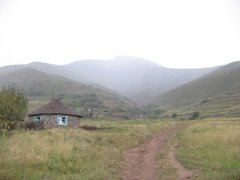
I don’t even know where to begin, so much has happened since my last update last month. To everyone’s amazement, I stayed in the tiny village of Mahlekefane (it’s not on maps – but it’s between the towns of Ha Lejone and Kow in the Maluti Mountains of Lesotho) for four straight weeks. I came down in my stay there only once, that was the last time I sent an update, when I was here in Hlotse to buy gifts for the teacher’s families. After that, I lived in the community, and became integrated with these fascinating, smiling, laughing, warm people so that I’m already homesick for Mahlekefane and I’ve been gone for only twenty-four hours. Even this morning, waking up in the Help Lesotho office in Hlotse (also called Leribe), I looked around for the familiar surroundings of my beloved, cozy mud and dung hut. My heart fell when I saw the electrical outlets, light switch and light bulbs.
 I took more than 2000 photos in Mahlekefane and could have easily taken double that, just in trying to capture my unbelievable life there, the breathtaking beauty of the surrounding mountains (which you really cannot capture in a photo) and the gorgeous children (who, fortunately, proved extremely photogenic, so I was able to capture them in a tiny way, to bring home!)
The people there get water out of a spring that they cover with a large flat stone so that the grazing cows and sheep do not dirty it. Surrounding the spring is thick dark clay. There is one grandmother in the village who makes handcrafted pots and fires them, literally, in the fire, this turns the clay much harder and changes it to an orange-brown colour. The children use the clay too. The little girls make small homes that look identical to the mud huts of the wealthier people in the village (those with furniture). The little boys make herds of cattle and dogs to guard them. Everything is done in intricate miniature, and I often, after a rain, when the clay is the best, watched with amazement as they built. After I was living there for about three weeks, the boys and girls alike began to make new toys out of clay. They began to appear, walking around the village, carrying homemade cameras, calling “Say cheese” to everyone they saw. My camera is the first one that many have seen, and they quickly learned how I used it. In imitation of my frequent shutterbugging, they built their own with shards of glass as lenses and flash. They even used dry grass to make straps to keep cameras safe on their wrists.
I have stopped eating meat (“nama”) because I cannot deal with looking at the animal and then having it appear on my plate. When I first arrived, I could not stomach the mutton intestines of the sheep that had been presented to me to pet and look at. During the time I spent at Mahlekefane, I was given four chickens as gifts and could only take the smallest bites of these birds who had been tied by their ankles in the yard of my Basotho family, awaiting slaughter and being chased around by my delighted Basotho sister, Makhumalo. The worst part of this is that the people giving me these generous gifts are not in possession of many things, especially not possessing many chickens. These gifts were truly heart-wrenching, as they represented such generousity of people with so little. I managed not to be insulting by being extremely grateful (“relebohile”) and offering them to share in the meat. The people at Mahlekefane rarely eat meat because of the expense, so they were always happy to share in the feasting. The teachers at the school think it is hilarious that I can eat meat from a shop in Canada but not from the animal in Lesotho. I am able to convince myself that the packet of chicken in Canada is just “meat”, but I cannot separate the chicken leg that appears on my plate from the orange punk-harried chicken that awoke me every morning, crowing loudly. This vegetarianism happened once before when I travelled, when I spent time in France in grade eight, and couldn’t bear to eat meat after seeing cows on their way to a slaughterhouse (one looked pleadingly, right into my eyes) and piglets squealing sadly in the blood of their recently slaughtered mother. That vegetarianism lasted almost five years. I don’t know how long this one will. I am craving a McDonald’s cheeseburger.
As I look back at this e-mail, I am laughing to myself as the news I am giving is not really news, just stream of consciousness, inconsequential tidbits. Like I said, I am overwhelmed. I have been out of contact with everyone I know for so long that I am having difficulty communicating effectively.
Expecting no Help Lesotho staff to be here in Hlotse now, I was pleasantly surprised to find my friends Mel, Cliff and Maseeiso all hard at work at the office when I arrived yesterday evening. I talked at an incredible rate for two full hours, jumping (literally and figuratively) all over the place. They just watched me with wide eyes. It has been so long since I’ve spoken ordinary English and not the Sesotho-English that I adapted while living in the mountains among people with little to no English.
I have had the most wonderful experience living at Mahlekefane. After the initial novelty of my skin colour wore off, I was accepted with open hearts, arms and homes to the community. Occasionally, I would meet another new child to whom I was the first ever “lakhoa” (white person) they had seen. Their reactions were alternately amazement and horror. So long as I took a while to come physically close, they were alright. Anytime I approached one of the fearful young ones, I was met with screams of terror from the child and screams of laughter from the parent. I became a part of the community, living, working, laughing and crying alongside them. I am so very fortunate to have been given this opportunity and so grateful that my experience was filled with so much joy.
During my five and a half weeks at Mahlekefane, there was a two week vacation for Easter and the Census that is currently finishing in Lesotho. Because I only had a limited time in the village, I wanted to make the best use of this time, so I operated a camp/school for the Standard Sevens for these two weeks. Standard Seven is roughly equivalent to our Grade Seven, but is the last year of Free Primary Education. Those students who come from families with lots of money or who manage to find generous donors (VERY few), and who have achieved high marks in Standard Seven (even fewer) may continue on to high school. They must board at high school, as there is not a school within walking distance of Mahlekefane.
Here I will stop and explain walking distance. In Canada, kids might walk up o a kilometre on sidewalks or at least paved roads to come to school. Most of the children attending Mahlekefane walk for at least 45 minutes to school. There are many who walk up to two or two and a half hours each way, each day. This walk is not an easy one, as it is up and down mountains on rocky paths or extremely narrow dirt roads. Adding to all this are the astoundingly bad quality of their shoes, they wear them until they literally fall off their feet, and then they leave them where they lie. Often, I would be walking around and find one lonely sole-less shoe lying one the road or in the fields.
Working with the Standard Sevens, I had to be very creative, as there are so few resources available at the school itself and the students’ level of English is very low. Over time, we worked out a wonderful system of games, stories, dancing, singing and hand gestures to communicate and I was happy to see the small but meaningful improvements in their spoken and written English over the time I spent with them.
I love them with all my heart and my departure was absolutely horrendous. The day before I left, the teachers had arranged for each of the seven grades to serenade me in turn. I was laughing and singing through the songs and dances that the Standard ones through six presented. Then, my Sevens took to the stage (facing me as I sat on a wooden bench). They sang a song that I love that they often sing at concerts or celebrations. I was fine, dancing and singing along. Then, they sang a song I had never heard. It was a Sesotho song, but my rudimentary knowledge of the language allowed me to translate the important parts. They sang, “Shauna, Shauna, Don’t forget Mahlekefane, Don’t forget M’e’ Ratia, Don’t forget ‘M’e Letata” and on and on, singing all the names of the teachers, with my name in between. I began to get misty eyed. Next, they sang, “Go in peace, Thank you, Thank you, Go well” (also in Sesotho). Many more tears. The other teachers all began to cry too. Then, to cap it all off, they sang “The Monkey Song”, a song made up by my brothers and that I taught to the Standard Sevens early and that they absolutely loved. There are actions and everything and they sang me that hilarious, happy song as I BAWLED. Then the principal serenaded me by herself on behalf of the teachers and made a speech in Sesotho that I caught enough words to continue crying. The kids sang the national anthem and I made a speech through my tears. Looking out at the 316 beautiful faces, there were many who were perplexed to see the “Mother of Joy” so upset. Then, their own tears started and I was given hundreds of wonderful, tearful hugs. My Standard Seven girls were sobbing and howling loudly, egging each others’ sorrow on, while a few of my tough little guys gave me blurry eyed hugs.
It was a difficult departure only because it had been such an easy stay. At Mahlekefane, I was met with consistent “pula, nala, khotso” (the national motto, meaning “rain, plenty, peace). I had an amazing experience, being accepted into this underdeveloped community where the people meet challenge and hardship with incredible strength, heartiness and find joy in anything and everything. The village itself was beautiful, but the people captured my heart, on new and exciting levels each day. I am in love with those people and will never, ever forget them or my time there. I had a totally unique experience, living among them and becoming one of them (the school motto is “Together as one – NO problems”) so much that I was absolutely at home there. They have sent their love to my loved ones. Family and friends in Canada are sent peace and happiness from my new family and friends in the mountains of Lesotho.
Returning to Hlotse, I was met with wonderful e-mails and even some packages that made me so joyful. Thank you for continuing to have interest in my adventures. Knowing that there are people supporting me at home makes me able to have the strength to get through being so far away, so out of touch and in such a totally different world.
I am on a five day break before I move to Thaba Tseka and Paray Primary School, my next position. I have to go to the capital city, Maseru to get my visitor’s Visa extended and am going to do some sightseeing around there as a break before I fall in love with a new village and new children.
I’ll be in touch each of those days, I have so much to tell, so much to wrap my head around that I’ll probably send more rambling messages.
Please, if you have any specific questions, e-mail me and I’ll focus on those things in my next e-mails. There is so much to tell , that it’s difficult to pick out just a few stories to tell.
Please keep the e-mails coming, they mean so much to me.
Lesotho Update #7
Friday, March 31st, 2006
Good morning! It's 9:49 a.m. here - you're all snoozing at 2:49 a.m., safe and warm in your beds in your heated (or perhaps by now, air conditioned homes!)
I will be leaving for Mahlekefane shortly. I have two huge bags of boots and coats for the teachers' kids and am so excited to see them in their new warm coats. It was difficult to find cozy warm things here - they don't have many warm North American style coats, because people dress in layers and top everything off with their heavy Basotho blankets, often worn as though they were capes.
I am spending four uninterrupted weeks in Mahlekefane and am thrilled. The two days I've been away, I've been missing the people there and the clean, clear air and absolutely breathtaking view of the mountains. It is totally indescribable, the beauty of the mountains (that is rivalled by the beauty of the people). The village where I live is on the edge of a mountain - agriculture is done on plateaus up the mountain. If you walk towards the school, you approach a steep slope down to a river that leads to the Katse Dam (the freshwater dam in Lesotho that belongs to the government of South Africa. The South Africans pay the Basotho $21 million a month for the dam...none of this filters down to anyone who needs it in this country). If you walk away from the school, towards my hut, you head into higher mountains, like the one I will be climbing tomorrow - the pyramid shaped Maleqatse (q is a click). I'm excited to get back to the village and see faces that have already become familiar and dear.
Last night, I was able to find supplies for makeshift S'Mores that we shared with our Basotho friends around a campfire. I have been staying with two wonderful Ottawa girls who are interns for a closely associated CIDA sponsored project called Youth Against HIV/AIDS. Donna and Mel have been wonderful support and I'm crazy about them. It was the three of us along with 'M'e Mahlmpho (the office neighbour and an incredible single mother of 3 living on an 800 Rand a month teachers' salary - her boys are very bright and succeed in school, but high school is crazily expensive, so she struggles) and her boys Matekoa, Mpho and Hlmpho. There were other friends there as well, a friend of the boys named Thabo (which you will recognize as part of my Sesotho name, 'M'e Mathabo!) and a woman who works at the nearby Leribe Craft Centre.
The Leribe Craft Centre is in the same compound as the Help Lesotho office and was a project created by 'M'e Mojaje (of long ago computer lessons - we actually had another this morning!) to create a livelihood for disabled women from nearby villages. They make beautiful mohair scarves (in wildly bright colours) with mohair collected from goats in the mountains at Ha Lejone (20 minutes from Mahlekefane). The women clean, dye, spin and weave the wool into gorgeous crafts. All of them are physically disabled and energetic, lovely and friendly. At the fire last night was one of the women - she is profoundly deaf and speaks in sign language only. She was delighted the entire night. As the maize roast progressed, we were joined by more neighbours (all the women who work at the Craft Centre live on the compound and wanted to join the fun).
We had a blast, singing songs, playing games, wishing on stars, learning sign language, eating roasted corn and S'Mores (the night watchman even stopped by for a treat!) and laughing at 'M'e Regina who told us stories of witches. This week, there has been a much discussed news item - a woman who reporters are claiming is a witch was found sitting in a taxi one morning, locked inside in only her "panties and petticoat". I don't know what this has to do with witchcraft, because she could have easily locked the door behind her after entering the parked car, but for some reason, her being inside the locked car, and barely dressed has made her a witch. There are some strange superstitions about witches that 'M'e Regina told us all about.
Mpho was waving a stick in the air after roasting marshmallows - the stick had a bit of burning ember at the tip. 'M'e Regina made him stop right away, as it was beckoning witches. There are all sorts of things you cannot do after dark - waving burning sticks is just one. If you leave out your laundry, cut your nails or your hair after the sun goes down, a witch will pick up your clothes, nail or hair clippings, sniff them and know that they are yours and will come and do terrible things to you (never specified). Before we went to bed, Donna took down all her laundry. 'M'e Regina's stories were hilarious, she is a gifted storyteller and uses her whole body and face to tell a story. She is hard of hearing and was teaching us signs by the fire. We laughed so hard. It was a wonderful night for me to be in town, the first time I have been outside after dark here!
Thanks once again for all the wonderful e-mails, the support and the news from home. I'm sorry I have been unable to respond to all individually, but I have read all messages and really appreciate them. It's only that the internet is so slow and expensive here that I don't get a chance to write lots of personal messages. When I get home, I promise to make up for it! Do know that your messages are being read and absorbed. I feel so energized and empowered from all the love and appreciation I have recieved from you. Thank you for that. You have helped so much in charging up my batteries for the remainder of my time here.
This break has been great, refocusing me and reminding me what I am doing here and I return to the mountains today refreshed and totally eager and enthusiastic. I will be back to Hlotse for a couple of days at the end of the month. I am coming down on the last Friday of April (the 28th, I believe) and will stay for the weekend. Because I will be back, I have arranged with the neighbour here (the beautiful 'M'e Mahlmpo, mother two three clever, funny and charming little boys) to collect any mail for me. This means that if you are interested, and can do it in the next couple of days, you can send me letters, photos or items from home! Mail takes about three weeks, so anything should be sent ASAP in order for me to be able to recieve it! I'd love somethings to read - a paperback, some current magazines (how I miss my celebrity gossip!), some tasty milk chocolate (the chocolate here just doesn't compete with ours and the small supply I bought in Switzerland is long gone, shared with other Canadian volunteers!). Most of all, I'd love letters and photos to keep with me. Anything that can be sent should not be very valuable, as I have been warned about the reliability of the mail here, but I would be SO happy to get anything from home! The mailing address is c/o 'M'e Mahlmpho c/o St. Mary's Home Economics School PO Box 707 Leribe 300 Lesotho. I brought many balloons which have been hugely popular, but I'm running out and they are not available here for a decent price. Also, the kids are crazy about the punching balloons (available at the Dollar Store in Canada), they're sturdy and attached to an elastic.
Any little sign of home will be so appreciated when I've been gone for seven weeks! Thanks once again for reading these and joining me in this journey, this wild experience!
I'll be in touch in late April or early May!
Happy April Fool's Day tomorrow,
Bye-byeeeee (as the kids say here, it's the cutest the way they raise their tone at the end of the second "bye")!
Thursday, March 1, 2007
Lesotho Update #6
Thursday, March 30th, 2007
Good afternoon, It is now 1 :16 p.m. Lesotho time (about 6 :16 a.m. in Ottawa)
(I'm finally getting around to sending this at 2:44 p.m. - most of you will be up already or getting up really soon! Have a fantastic day!)
I attempted to write this message this morning, and got about halfway through when the internet abruptly stopped working and my message was lost. I’ve been gone a couple of hours and just came back in, asking the manager if the internet will continue to work this time, he said that he wishes it will. I’m keeping my fingers crossed (which is very difficult when you type), but as a precaution, am writing this e-mail on Microsoft Word. When I was first in here this morning, I was met with lots of new e-mail messages. My eyes filled with tears and I was left clumsily wiping them away as I read message after message of love and encouragement. Thank you to all of you who are reading these messages and especially those of you who are taking the time to respond. The support means SO much to me. Thank you thank you thank you!
Today my shopping has continued, I have bought all the jackets and boots save for one set. I’ll stop by the shops this afternoon to look again.
Let me tell you about my hut in Mahlekefane. I live in a round hut (called a rondavel), made of mud and cow dung with a beautiful thatch roof. It is quite roomy – with a radius of about 9 or 10 feet. There are a few closets in the single room, filled with the clothing and blankets of the Letata family (my hosts). I sleep on a double bed which has a mattress and a frame and is off the floor. I sleep under three Basotho blankets – very cozy and with a pillow made of my unused clothing. The pillows here are too lumpy for my liking, and after a few nights using them, I gave up for the softer clothing alternative.
I have bedside tables attached to my bed, on which I rest several candles – I like lots of light. When they’re extinguised at night, the darkness is so totally complete that you cannot see a thing. The mud floor is covered in linoleoum simulating wood and there is a short dressing table with three large mirrors. I was actually looking forward to being away from mirrors, but now I actually have to look at myself each morning, so I am happily using the warm water that my ‘M’e (Mother) brings me to bathe with.
I even have a small table in my hut, on which I sometimes eat (when I can escape the watchful eyes of all my friends in the village – they love to watch me eat!) soup. I am consistently fed HUGE meals and once in a while, need a break and have some instant soups in my hut. There is a huge bag of maize meal that the Letata family keeps in the hut in which I am living. There are also kitchen type cupboards in which they hold many dishes and cooking implements, as well as extra candles, sugar, flour, etc.
Like most families in Mahlekefane, the Letatas have more than one hut. Each hut is like a sepearte room and is used for a different purpose. I am sleeping the the ‘storage’ hut and they sleep in the ‘kitchen’. Pietir Letata is a coal miner who comes home for one or two nights a month and Ntsiseng, the 12 year old daughter lives with her grandparents, so it is just Menkalimeng (my ‘M’e) and Mahkumalo. They sleep together on a single cot in the corner of the very bare kitchen hut. When I asked why they do not use the beautiful hut in which I sleep, as I would be very happy to sleep on a single bed, ‘M’e tells me that she hates the cold. The kitchen hut is much warmer, as it is where all the cooking happens. Don’t think that I am being neglected though, the past few nights were pretty cold and I was given extra blenkets and the use of a neighbour’s heater for the evening (I’m being taken care of so well that I feel awful for all the people who need so much more and volunter to help ME out).
Anyway, my hut is a traditional Basotho hut, but well taken care of (like everything here! The four year olds learn to shine their shoes daily), and very comfortable. There is obviously no electricity or running water, but I will often wake up, feeling like I am in my own bed in Ottawa.
On the first day of the feast for the returning initiates, the men paraded into the field surrounded by their dogs. The dogs in Lesotho are not like our pets in Canada, some are beautiful, but they are trained not as housepets and companions but as vicious guards. The herders (the initates) have the most beautiful healthy dogs. When they arrived into the village, led by their proud dogs, each man and dog was decorated in red ochre. At the commencement of the ceremony, with the dogs settling in next to their singing masters, there was one dog sitting on the periphery with the women who I’m certain was frowning. He looked so sad. He kept approaching the area wiht the painted dogs and looked sadly around, obvioulsly envious of their adornments and high status. I got a photo of him hanging his head after he realized he truly didn’t fit in.
The family with which I live has a cat, named ‘katse’. The animals are not given names, but are simply called their Sesotho names (a dog is an ‘nja’). He is a tiny little cat who is very snarly and hissy. When I have tuna, I give him the water from the can. I’m trying to befriend him, but it’s not really working. His ears are both snipped at the tops. This is so that he will stay near home. Apparently he was running away to the ‘forest’ (there is, in fact, nothing CLOSE to a Canadian forest in Mahlekefane – there are maybe three gatherings of two small trees each), so I’m not sure where the cat was going. Nor am I sure where kids go to the toilet, as I am told they go in the ‘forest’), and in order to scare him from the forest and back home, Ntate Letata took him to the forest and snipped his ears. Thus forth, he stays near home. Yikes.
I am working wtih the children on basic vocabulary, including colours – which are fun and easy to teach, as you can point at anything to practice. Before I left for Hlotse yesterday morning, I went to visit my pal, Masefatsa who was resting in bed after a sudden seizure the night before (I am going to the hospital with her and her grandmother on Sunday). She was feeling OK, but tired and achy (understandably), and she began her favourite game of telling me colours of things. I would point at something and she would say the colour, my bracelet, ‘rrrred’ (she rolls her ‘r’s adorably), her blanket, ‘grrrreen’, a plant, also ‘grrrreen’. Then she pointed at my hand and said ‘white’. I pointed at her hand and asked what colour, she said, ‘grrrrreen’. Whatever you say. She also loves to be tickled – The Round and Round the Garden Game, Spiders Crawling Up Your Bag (note: this was supposed to say "Spiders Crawling Up Your Back", but it's pretty funny to leave the original typo) , and This Little Piggy. She’ll climb into my lap and present me with whatever part of her body she wants tickled. For the Round and Round, I am presented with a tiny perfect palm, Spiders get her head tucked down and her back rounded and the Piggies mean her shoe is kicked off and her tiny toes are in the air.
The kids have started to lead one another in the ‘Hands Up’ game we play. It’s great – they practice their English and warm up from the cold. One person shouts out directions which the group repeats and then does the action. They love ‘wiggle, wiggle, wiggle’ and ‘shake, shake, shake’. Everyday I try to expand the actions and vocabulary, but when they lead, they stick to the old standbys!
The day that the classrooms were being smeared, the kids were able to play with their toys outside. I saw some amazing things – the most detailed cars and trucks made out of wire (one had a trunk filled with Coke cans, rearview mirrors and even an accessory hanging from the main rearview!), the hoops and sticks similar to those who remember studying pioneer Canada, rocks used to play a checkers type game on a larger rock on which a gameboard has been set up using a small rock to carve into the surface, and many animals and houses made out of clay from the area surrounding the spring (we get water from the freshwater spring and I chlorinate it to drink). The toys I brought have been incorporated into their play beautifully.
I have been practising daily carrying things on my head, one of my steps in becoming a true ‘Masotho woman’. I carried a five litre bucket of water from the spring to the school with just one hand for balance. Pretty good. The women are helping me by constructing rings out of scarves for me to rest on my head as support. I am getting better though. Don’t be surprised if you see me walking the streets of Ottawa with a sewing machine or logs on my head (I have seen women carrying the most incredible things!)
I’ve pulled out my puppet (who’s name is ‘Bapala’ – Sesotho for play) a few times to hilarious reactions, some kids were initially terrified. Then Bapala started kissing some kids and the others all wanted in on the action. When I introduced Bapala to the adults, their reactions were identical – a few rough, grown men screamed and ran away in terror to the laughter of their friends, while some happily accepted Bapala’s kisses. One man tried to get a kiss from me instead of Bapala but I laughed it off (as I do with the numerous marriage proposals I recieve each day. People think that because I am white, I am rich and am their ticket to a better life. I wonder how one of these forward men would react if I just up and said yes. I’m not going to try, for fear that it would be binding!) Bapala now has a messy mouth and tongue from kissing so many people, but he and his fans are happy!
I gave the soccer balls along with other sports and school equpement to the principal, ‘M’e Ratia on Monday, and things were distributed on Tuesday afternoon. Along wtih the things I had brought, about 100 hats and a bunch of toothbrushes that were donated by other Help Lesotho volunteers were given out. The toothbrushes and paste were given to hte double and single orphans. A child here who has had one parent die is called a single orphan, and what we would call an orphan is here called a double orphan. The hats were given to the double orphans and all of the kids in calss one (the equivannet of our grade one, but with a big range of ages, from three to nine). ‘M’e Ratia handed out the new soccer balls, one to the girls for net ball (esentially basketball without the dribbling) and one to the boys for football (our soccer). The grade sevens are the ones who play, and all the other students, grade one to six stand on the sidelines. At first I thought, ‘how boring for them’. But then the game started. The grades one to sixes are responsible for provinding morale, they sing and dance (special morale boosting songs) and cheer things like ‘Many lions!’ in Sesotho (I think it’s like us yelling De-fence!) It’s fantastic to watch them in their physical education, the songs are all sung in beautiful harmony and the dance steps just add to the whole effect. The same thing happens when the grade sevens train for running. They run barefoot for 1 ½ hours as the younger students boost morale with song and dance. The kids are amazing runners and due to the high altitude and their incredible lung capacity, are fantastic competitors against the kids in the lowlands.
Primary school here is free and goes from grade one to grade seven. Grades 8-12 are high school and are called Form A, B, C, D and E. High school is expensive, so many children are unable to attend. This is why Help Lesotho sponsors many older children, as they are the ones who need help to pay school fees.
Tonight, the office staff and I have been invited to the neighbour’s for a maize roast (these are the three little boys and mother who live in a one room apartment next to the office). I have been recruited to bring marshmallows to roast and I’ll see if I can scrounge together some chocolate and graham cracker type cookies to let them try S’mores (there are cookies here called Maria biscuits which taste exactly like Arrowroots – yum!)
Even better than the Marie biscuits, though, are fat cakes. This is cakey dough that is deep fried in fat (usually corn oil these days). They are amazingly greasy and delicious adn taste like Tiny Tom’s doughnuts. On the way to the internet cafe, I saw a bunch of school girls heading past me carrying bags of them, apparently they can be purchased on the main street in town. I’ll go on a hunt after sending this e-mail!
Soon in Mahlekefane, there will be a World Food Program delivery and a cultural day with the traditional male and female dances. I can’t wait! I’ll tell you all about it in May, when I’ll be coming down next (Sam, I’ll be thinking of you on your birthday!)
Note to excuse errors
For the most part, these e-mails have been untouched since they were sent from Lesotho. Please excuse spelling, grammar and punctuation errors. I'll take some time later to correct them, but for now it's a fun game for you to spot out the mistakes. That's one of my favourite things to do, actually - make corrections to other people's writing. I sometimes edit the newspaper, novels or magazines. So cool.
Subscribe to:
Posts (Atom)